
|
Are you considering
the purchase of your first telescope? There are several factors to keep
in mind. How you intend to use the telescope – daytime as well as night
time use or primarily for astronomy or for photography - will be a significant factor in
the type of scope you will choose. Most telescopes can also be paired with a camera.
The Warning
Firstly you should take warning from numerous articles about “department trash scopes.” Terence Dickinson is one of
Canada’s best known astronomers, astronomy educators and editor of
SkyNews. He has written over 35 astronomy books including the best
selling, NightWatch, which is still the best primer for someone
beginning in astronomy. In a section of NightWatch which deals with
astronomical equipment he writes about “Trash Scope Blues” and warns
against purchasing the $200 department-store telescope announcing
450-power and several accessories in a box with colorful photos of
comets and planets. Our own experience at public events and at trade
shows is of many people who have one of these telescopes and who are
frustrated at not being able to use it or see anything but the moon.
Sadly, many people are turned off from astronomy because they have
spent good money for poor results. It becomes difficult to convince
them that economical equipment is available that is easy to use and
will give them exciting views of hundreds of beautiful celestial
objects.
In previous years the glossy photos and promises of high
power were bait to catch the unwary shopper. Today the computerized
mount on telescopes priced below $500 equally appeals to some the
technological instincts of many. Terence Dickinson says, “walk right
past the computerized telescope that’s on sale for less than $500
(sometimes much less) in your local big-box discount store. Hundreds of
thousands of these scopes are cranked out each year. SkyNews has tested
this category of telescope and given models to beginners to try. Our
conclusion is that computerized instruments in this price range should
be avoided.” Of course there are exceptions to every rule and now SkyNews (July/August 2008) has given a positive review to the Celestron 130 SLT which is priced at $439.95.
So Many Choices – How do I decide?
When choosing a telescope, the most important question to ask yourself
is, “How do I mostly want to use the telescope?” If you have a cabin at
the lake or a condo in the mountains or a villa by the sea and you want
to primarily use the telescope for daytime viewing, you will choose a
telescope quite differently from one that will be used primarily for
nighttime viewing. However, the best telescope will be the one that you
use the most. If the telescope has poor optics and a wobbly mount like
the department store trash scopes, you will not use it long. Nor will
you use a really good telescope if it is to heavy and cumbersome to set
up.

Let’s begin with the premise that you are looking for a telescope
primarily for astronomy. Astronomy is about collecting light from
distant objects and the first general principle for astronomy is that
you will have a better view if you can collect more light. This means
that a larger telescope generally is a better choice than a smaller
telescope. This leads us into the discussion of the two major types of
telescopes – refractors and reflectors.
A refractor
uses glass lenses to “refract” or bend the light and bring it to a
focus at the eyepiece. This type of scope is often what we think of as
a telescope because we look in one end and point the other end toward
the sky or toward the object we want to observe. A refractor generally
will give sharp, high contrast views of the moon, planets, double stars
and some star clusters.
In contrast, a reflector
uses a concave mirror and a second flat mirror to “reflect” the light
to a focus at the eyepiece. The advantage of a reflector, also called a
Newtonian, is in the ability to build a larger mirror at a lower price
than the lens of a refractor. All of the large telescopes in Hawaii,
Chile and even the Hubble are reflectors, using mirrors up to 10 meters
in diameter to collect light from distant galaxies. For regular
consumers, we rarely see a refractor with lenses larger than six inches
in diameter. Lenses larger than 6 inches become too costly to
manufacture and they introduce distortion that is difficult to
overcome.
So which should you buy? If your interest is in
viewing the planets and the moon, some double stars, a few nebulas and
a few star clusters, a refractor with a 100 mm to 120 mm objective lens
may be a good choice. Refractors with smaller lens from 60 mm to 100 mm
may also offer excellent views if the telescope has good quality
optics, mount and tripod. You should be aware that these scopes of this
size are often the ones promising far more than they are capable of
delivering.
However,
if you are interested in brighter and clearer views of “deep sky”
objects such as star clusters, nebulas and galaxies a reflector with at
least a five inch mirror likely is your choice. Because the size of the
mirror will determine how much light you collect, I always encourage
people to purchase the largest reflector that they can handle and
afford. Those who purchase telescopes with an eight or ten inch mirror
are able to find more and more celestial objects. Their interest in
astronomy often grows more quickly than those with smaller telescopes
because there seems to always be more and more to find and view. Many
people experience “aperture fever” where they continue to purchase or
build bigger and bigger telescopes for the bigger and brighter views. A
reflector still offers excellent views of the moon and planets although
a smaller refractor may offer a sharper, higher contrast view.
Compound Scopes:
A third type of telescope is a combination of the refractor and
reflector known as a “Schmidt-Cassegrain” or “Maksutov.” Both of these
scopes use a similar principle in bending light three times before
bringing it to a focus at the eyepiece. These telescopes can be a bit
more expensive due to additional manufacturing but they offer a compact
telescope with a longer focal length and thus, higher power. For many
people the higher power is a disadvantage as objects are more difficult
to find and appear to jiggle more readily because of the higher power.
But on a stable mount and with a little patience you will enjoy the
high magnification views from these scopes. Their advantage is
sharpness, compactness, transportability and quick set-up.
Different Views
If you were to look directly through a refractor, the image would be
upside down and reversed (mirror image). A 45 or 90 degree diagonal is
almost always included with a refractor for ease of viewing and the
diagonal also brings the image right side up. Sometimes the view is
still a mirrored view with everything right-side-up but reversed. Views
through a reflector are almost always inverted. When looking at
planets, star clusters and most celestial objects, the observer is not
aware that the view is inverted. This makes most reflectors unsuitable
for daytime viewing.
Different Mounts
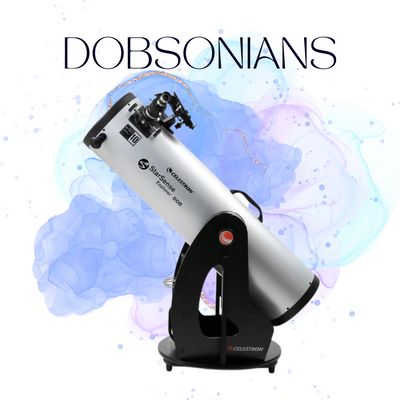
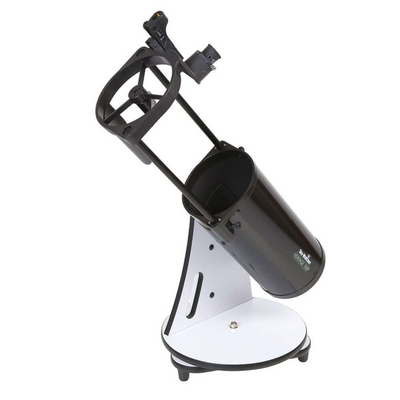
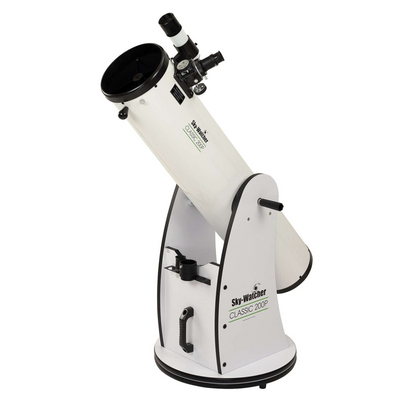
1. Dobsonian mount
– Named after John Dobson who developed the initial simple design, this
type of mount allows you to manually move a reflector simply and easily
in all directions. As the earth spins and stars move across the sky
along with the sun and moon, you will regularly nudge the Dobsonian in
the direction of the star’s movement. These telescopes have been called
“light buckets” because of the large amount of light they can collect
at a minimal cost. Terence Dickenson recommends a six inch or eight inch Dobsonian reflector as an ideal beginner’s scope. If you
can handle a 10 inch Dobsonian you will have even bigger and brighter
views. Many of us began our exciting journey of celestial discoveries
with a Dobsonian. Prices have dropped in recent years on most
telescopes with an eight inch “Dob” selling in the $400 range rather
than in the $700 range only a few years ago. Of note, “Dobsonian” refers to a style of mount that is made available by
several manufacturers. As recently as 2007 John Dobson, now 92 years
old, was speaking to star parties and assisting with his astronomy
group in San Francisco.
2. Equatorial Mount
– Both reflectors and refractors come on equatorial mounts. With an
equatorial mount you point the polar axis toward Polaris, the North
Star. Once you locate the celestial object you will turn a single knob
to keep the object centered in the eyepiece in contrast to nudging along the Dobsonian. On some equatorial mounts motors
drive the mount rather than having the observer turn a knob. While an
equatorial mount may initially seem daunting and difficult, it can be
quickly mastered and offers other advantages such as having the
telescope up on an adjustable height tripod.
3. Alt-Azimuth Mount
- This type of mount may be thought of somewhat like a camera tripod
mount where you move it up and down and sideways. This is a mount that
offers simplicity of use along with the advantage of having the
telescope up on a tripod. You find refractors and compound scopes on
this type of mount.
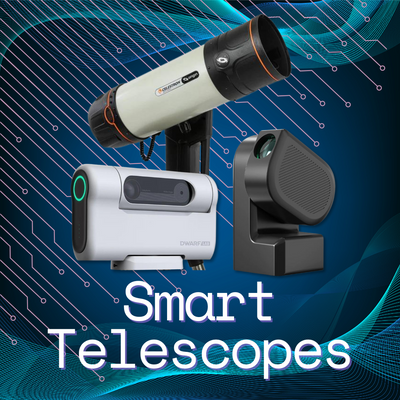
4. GoTo Mount
– In recent years computerization has entered the field of astronomical
equipment. Many young people come to astronomy through their technical
knowledge which is applied to astronomy. A GoTo telescope usually needs
some form
of alignment with certain stars or planets and then is able to follow
those objects and move its motorized mount to hundreds of other
designated celestial objects. Celestron and Sky-Watcher are two
manufacturers of GoTo scopes that are popularly available.
What Will I See? 
We
have chosen a fairly arbitrary standard for recommending a telescope.
We think you should see Saturn’s rings. Many people have traced the
beginning of a wonderful journey in astronomy to their first view of
Saturn and its rings. Unless otherwise noted, all of the telescopes we
recommend will allow you to see Saturn and its rings, Jupiter and its
four moons, the Orion nebula, hundreds of craters on the moon, and
numerous star clusters and double stars. All telescopes will allow you
to see the oval structure of the Andromeda galaxy. Telescopes with at
least a six inch aperture will allow you to see additional galaxies
such as the double galaxy M81 & M82.
Our Recommendations:
The best value in an astronomical telescope is the Dobsonian reflector.
You will need some simple sky charts such as those available in the
monthly astronomy magazines or in NightWatch to know where to point the
telescope. I am not aware of anyone who has returned a Dobsonian
because it disappointed them. Many, however, quickly trade up to a
larger Dobsonian because the simplicity of use, economical price and
exceptional views of “deep sky” objects have made them avid observers
who want to see more things and to see them more clearly. Again, we
recommend the largest scope that you can manage and afford. This scope
is easily transported if you have space in your vehicle for it. You
will also need a place to store a Dobsonian. While Dobsonians can be
purchased in many larger sizes, the most popular sizes are with 6 inch,
8 inch and 10 inch mirrors. A Dob with a 12 inch mirror is also
available under $1000 but it is almost more than one person can handle.

Another economical reflector is the 5 or 6 inch telescope on an
equatorial mount. The advantage to these telescopes are in gathering a
significant amount of light and having the telescope up on a tripod
where it can follow a celestial object with turn of a knob. They can be
somewhat more readily moved in and out of the house than a Dobsonian.
An inexpensive version of this telescope is the 114 mm ( 4 1/2 inch)
costing around $200. If funds are seriously limited, this telescope can
offer reasonable views of the moon along with some of the planets under
good, dark skies. However, we would recommend something larger such as
the 5 or 6 inch models.
The Celestron NexStar 130SLT is similar to the above Sky-Watcher but for about $150 more, it includes a full "goto" system. After an initial set-up and alignment, this telescope operates on the same "SkyAlign" system as its bigger cousins costing thousands of dollars. While a computerized telescope under $500 was not recommended earlier by the editor of SkyNews, this telescope has now received a favorable review in the July/August 2008 SkyNews. The reviewer says, "A generous aperture and ease of use make the NexStar 130SLT an attractive choice for those who want a computerized GoTo instrument that's a step up from the typical beginner's telescope." - p. 33
Recommended Refractors
There are a variety of refractors available and it is difficult to
narrow our recommendation down to one or two. We tend to favor
telescopes with as much aperture as you can handle and afford. The 120
mm Celestron Omni is an excellent refractor. A refractor with a longer
focal length will give you the sharpest views. This telescope is
mounted on an equatorial mount that is easy to maneuver and track
celestial objects. Other refractors with 100 mm objective lenses and
smaller may also give you good views if the they have good optics, a
solid mount and longer focal length. However, a lot of department store
trash scopes fall into this category so you will need to be aware of
the quality of the telescope.
For a first time telescope in the $200 range we recommend
the Celestron AstroMaster 90AZ . This telescope is easy to use both for daytime terrestrial viewing and for nightime celestial viewing. The AZ mount is much easier to use than the equatorial mount which could frustrate first time users. You will get good views of the moon as well as see Saturn's rings.
A GoTo Scope
If you would like to jump into astronomy with both feet, a compound
scope on a fully computerized GoTo mount may be the scope for you. A 58
year old purchased a 9 1/4 inch compound scope (Celestron CPC925) as
his first telescope and has been thrilled with the exceptional views.
He commented, “this is an amazing instrument…. I could never find and
see these objects without this technology. For a person who is so
ignorant about the skies and see these objects in a two hour period is
absolutely remarkable. I saw things last night I have never seen
before. It was a very special and may I say a worshipful time as well.”
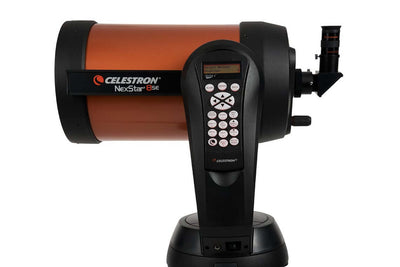
A less costly GoTo telescope that still brings in incredible views
is the Celestron NexStar SE series. While available in 4 and 5 inch
models, we recommend the 6 or 8 inch models. Both the Celestron CPC and
NexStar SE telescopes were reviewed in the January/February 2007
SkyNews magazine. Terence Dickinson said, “These scopes are a joy to
use….Time after time, it was a pleasure to see each new object emerge
right there in the field, with enough magnificaion to see it well. This
powerful astronomical instrument is ready
to offer a lifetime of observing pleasure…I had similar results with
the 6-inch SE….Here are two well-behaved telescopes that get my full
five-star recommendation.”
A Great Dual Use Scope
If there was one telescope that we could recommend for the best of
daytime and night time observing, it would be the Sky-Watcher 120 mm
refractor on an Alt-Azimuth mount. For daytime observing this telescope
is simple to set up and use. You can leave it set up on your deck or in
font of the living room window and easily pick it up and move it to a
new location. It is on an adjustable tripod which allows comfortable
viewing. This is a favorite scope for folks who want to watch what is
happening on the lake, out on the ocean, on the side of the mountain,
out on a prairie field or up in a distant tree. Even with the attached
tripod you can carry this telescope short distances if you need a
better vantage point. In contrast to the Omni 120 recommended under
refractors for astronomy, this 120 mm refractor has a shorter focal
length which results in a wider field of view. You can increase the
magnification with the second eyepiece for a closer look at your
subject.
The telescope also works well for night time observing.
Because of its 120 mm aperture you will still draw in enough light to
see planets, star clusters and hundreds of craters on the moon. The
rings of Saturn are also visible, especially with the higher power
eyepiece.
The mount is simple to use, offering both fast and slow motion controls in vertical and horizontal directions.
In comparing this telescope to the 120 Celestron Omni, you will find
the Omni to be a better telescope for astronomy but the longer length
and equatorial mount make the Omni a bit more challenging to use for
daytime viewing.
Photography
Most telescopes can be paired with a camera . Read our section on "astrophotography" for various possibilities including daytime photography.
Conclusion
Whatever telescope you purchase as your first telescope, we recommend the purchase of the NightWatch.
This is still the best introductory book for those beginning in
astronomy as it helps you to quickly identify the constellations in the
night sky and to find the nebulas, double stars, star clusters and
galaxies within each constellation. A second important accessory is a
moon filter for comfortable viewing of the moon. When viewing the moon,
we are viewing an object standing in broad daylight and the telescope
collects hundreds of times the light that your eye collects. So without
a moon filter it is similar to someone shining a flashlight into one
eye. A moon filter, also called a neutral density filter, will simply
cut the amount of light from the moon and allow you to continue
observing other objects also. A third recommended item is a red LED
flashlight. It can take up to 20 minutes for your eyes to adapt fully
to the dark. Once your eyes are fully adapted to the darkness, you will
be able to see everything, including the fainter nebulas and galaxies
better than if your eyes are not dark adapted. A red LED flashlight
allows you to change eyepieces and read sky charts without losing your
night vision. These three items are sold as a package or individually.
Finally, let us encourage you to take the plunge. You will have a
lifetime of observing enjoyment if you purchase a telescope knowing its
capabilities. When compared to a lot of recreational products,
astronomy is affordable and enriches your life in ways not otherwise
possible.
May all your skies be clear!
|